

A Career Built on Instruction, Enforcement, and Contract Mastery
Rex Venator began teaching as a young martial artist in the late 1970s and continued through the 1980s and 1990s while simultaneously earning real-world experience in both military and civilian law enforcement. Instruction, discipline, and leadership have been foundational to everything that followed.
Origins of Critical Response Training & the Bailspeak Program
In 1994 Rex conceived what later became the Critical Response Training Academy, fully activated in 1997. Classes included a one-day lawful bounty hunting seminar followed by 72 hours of real-world, street-level fugitive recovery training.
This groundbreaking model directly led to the creation of Bailspeak, which remains active today as one of the most respected bail training programs in California.
Pioneering Bail Contract Law & Bail Motion Practice
Beginning in 1997, Rex entered the highly technical world of curing forfeited bail bonds, a process that demands deep understanding of:
Judicial procedure
Contract law
Statutory obligations of sureties and bail agents
Civil liabilities
Court-recognized performance standards
For decades, Rex’s work has included:
Identifying procedural defects in forfeiture actions
Drafting motions for Superior Court
Appearing personally to argue and win hundreds of forfeiture-related matters
Developing contract-based defenses that are now widely imitated
Rex’s contract work is historically significant. He is among the earliest in California to successfully argue:
Government interference with a private civil contract
Impossibility of performance due to government action or obstruction
Unconscionability and imbalance between contracting parties
This body of work is directly tied to private contracts between sureties, bail agents, and indemnitors, and demonstrates long-standing, practical contract expertise—not academic theory, but real operations involving high-stakes financial liability and statutory compliance.
Today, Rex teaches bail contract law and law & motion in courses approved by the California Department of Insurance, based on decades of hands-on contract interpretation, drafting, litigation support, and expert analysis.
Educator, Author, Innovator
By 2006, Rex had become a published author, instructional DVD producer, and a nationally recognized speaker at bail industry conventions.
In 2007, he independently conceptualized and wrote an entirely new brand of bail curriculum—later approved by the California Department of Insurance—and launched Bailspeak, which quickly became the most successful bail education school of its kind.
Requests for online training poured in from across the country; Bailspeak’s digital programs extended that legacy nationwide.
Expert Witness Work & International Media
Since 2009, Rex has served as an expert witness in state and federal cases involving:
Sureties
Bail bondsmen
Bounty hunters / fugitive recovery agents
Bail contracts
Liability issues
Custom, practice, and standard of care
He has produced expert opinions for criminal defense, prosecution, civil plaintiffs, and civil defendants, with notable federal work for major sureties.
Between 2010 and 2018, Rex appeared on British News, Croatian television, and in the French documentary US Marshals: The Big Business of Fugitives. His online videos have accumulated over 5.5 million views.
Agency Experience & National Influence
From 2010 to 2018, Rex helped launch numerous bail bond companies as a General Agent for two nationally recognized sureties—providing guidance on operations, contracts, compliance, and liability.
In 2011, he became a TASER Certified Instructor authorized to certify bounty hunters in Conducted Electrical Weapons. He also served on a California Department of Insurance Ad Hoc Bail Advisory Subcommittee focused on pre-licensing education and exam development.
Continued Media Presence & Public Education
In 2017, Rex appeared on the Mitú Entertainment Network’s hit show “Cholos Try…”, and in 2018 he launched the Special Access Program (SAP) YouTube Channel, offering free educational content on bail, fugitive recovery, and critical legal topics.
Rex’s current project, the Bail Instructor Academy, is in development and has already drawn interest from reality TV producers.
The Only California Instructor With This Proven Track Record
At the time of this writing, Rex stands alone as the only verifiable California bail education instructor with multi-decades of documented and lawful experience:
Running bail bond agencies
Drafting and filing bail motions as an appointed agent of sureties
Arguing those motions in open Superior Court
Teaching bail law and contract law under state approval
Conducting lawful fugitive recovery operations consistent with Insurance Code, Penal Code, and Title 10 regulations
Over 5,500 people have earned Bailspeak Certificates, and major bail industry recruiters routinely direct their new hires to Rex for training—often exclusively.
Recent speaking engagements have included national conferences such as in Las Vegas, San Antonio, Nashville, Tennessee, and private government gatherings.
You Should Always Consult with an Attorney for Legal Advice
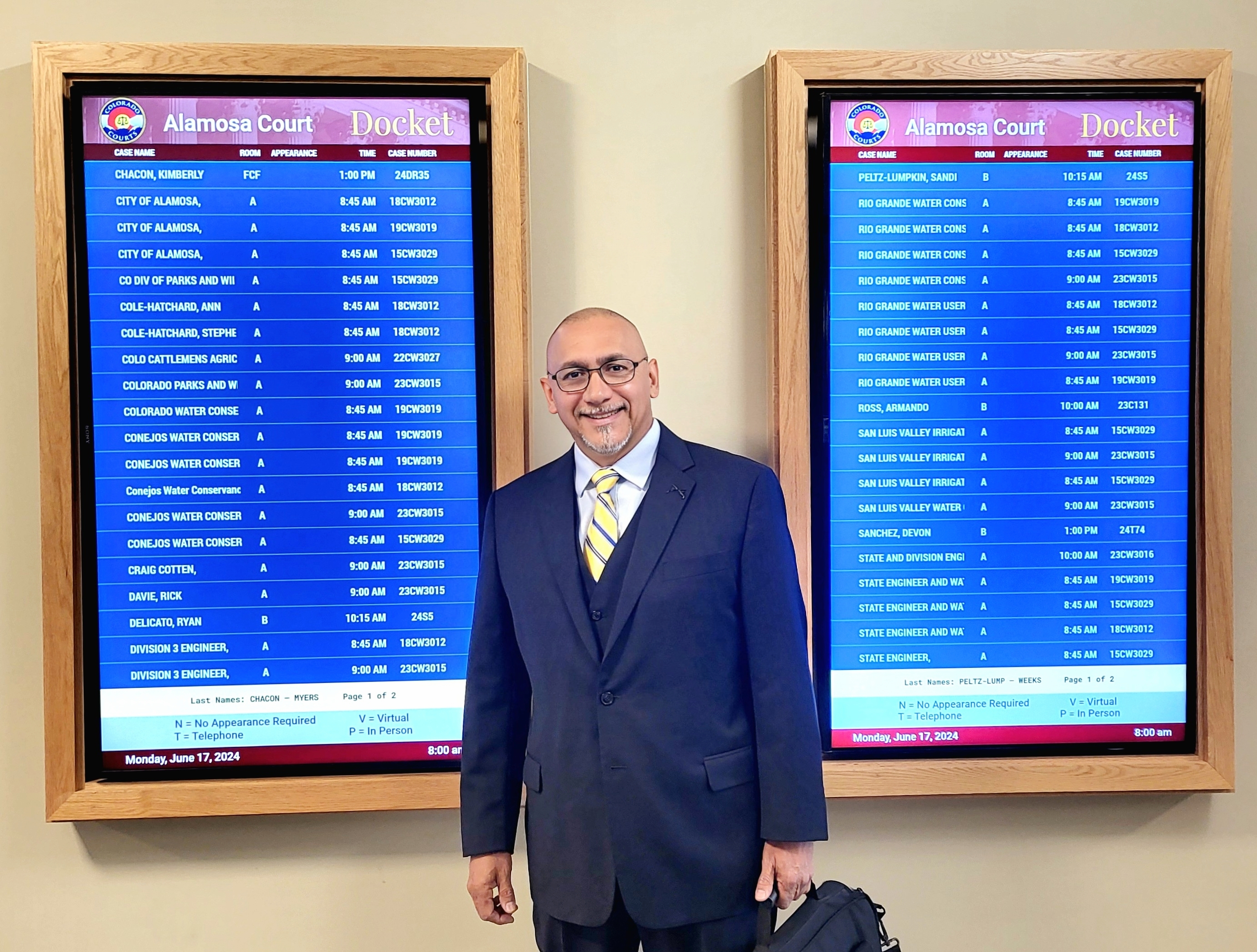
Can a Bounty Hunter Appear in Court on Bail Bond Motions?
Government Requested Expert Witness Layman's Opinion
The following is based on my personal, layman’s opinion as a private citizen who is simply observing his civic duty.
Pursuant to the email request, the following is my expert opinion regarding bounty hunters drafting moving papers and appearing in court for a bail bond surety.
The statute provided by the bounty hunter isn’t consistent, in my personal opinion, with a licensed bail agent, appointed as an agent by the real party in interest bail bond surety moving a court, drafting and appearing under penal code law—so long as the bail agent is appearing for a sole proprietorship and not a bail bond corporation.
Expert Opinion with Citations
It is my personal, layman’s opinion that Penal Code §1305 subsection j does allow for “the bail agent” to draft and appear for an unincorporated bail bond company when he or she is appointed by the surety upon which the bond was written.
It is my personal, layman’s opinion that Penal Code §1305 subsection j carries greater weight and is deemed controlling over Business and Professions §6125 for the purposes of bail agents drafting and appearing on instant, civil matters injected into an existing criminal matter before a superior court.
There are published case cites, however, where the Civil Code of Procedures has sections that are controlling over certain Penal Code, bail related sections, but, for the purposes of this personal opinion analysis, bounty hunters who are not licensed bail agents and appointed by the surety do not have standing under Penal Code §1305 subsection j to draft and appear in superior court and are subject to Business and Professions §6125 penalty—in my personal, layman’s opinion.
It is my personal, layman’s opinion that the curiously lamented reference to an obscure California Civil Code of Procedure section that allows for a bounty hunter “surety insurer” to draft and appear in court is seriously flawed and fatal to any bounty hunter’s argument to the extent that Civil Code of Procedure 995.120 subsection a and b defines a “surety insurer” in part as follows: “‘Admitted surety insurer’ means a corporate insurer or a reciprocal or interinsurance exchange to which the Insurance Commissioner has issued a certificate of authority to transact surety insurance in this state, as defined in Section 105 of the Insurance Code,” “For the purpose of application of this chapter to a bond given pursuant to any statute of this state, the phrases ‘admitted surety insurer,’ ‘authorized surety company,’ ‘bonding company,’ ‘corporate surety,’ and comparable phrases used in the statute mean "admitted surety insurer" as defined in this section.”
Whereas, it is my personal, layman’s position that a bounty hunter appearing for a bail bond company as an independent contractor is, arguably, not drafting and appearing as an agent for the surety in any capacity and in such instances the matter in question then defaults to Business and Professions §6125 primarily because one well established structure of bail agents appearing for their own non-incorporated bail companies in superior courts reverts to another dictum based structure where, plainly stated, a private citizen—not even a corporate officer of the surety, which is also not applicable for the purposes of this personal, layman’s analysis—is somehow not even appearing in propria persona for the corporation and is likened to any person simply walking in off the street not to self-represent but to represent an entity that he or she isn’t even a corporate officer or shareholder of and all of which is because the bounty hunter is not a licensed bail agent who is appointed as an agent for any surety.
To be succinct in the interest of brevity, in my personal, layman’s opinion, a bounty hunter working as an independent contractor for a bail bond company is disallowed to appear under Penal law; moreover, Civil Code of Procedures does not apply because in the absence of Penal law applications the bounty hunter is then personally appearing for an incorporated surety where, arguably, said bounty hunter is engaging in the “unlicensed practice of law;” indeed, a corporation is not a natural person and cannot appear in propria persona; it can only appear through counsel with the exception of sending a corporate representative to small claims under Code of Civil Procedure section 116.510.
References & Citations
Thus California today defines law practice as providing “legal advice and legal instrument and contract preparation, whether or not these subjects were rendered in the course of litigation.” Birbower, Montalban, Condo & Frank, P.C . v Superior Court., supra, at 128. Providing legal advice or service is a violation of the State Bar Act if done by an unlicensed person, even if the advice or service does not relate to any matter pending before a court. (Mickel v. Murphy (1957) 147 Cal.App.2d 718, 721.)
The lead case on this is Paradise v. Nowlin (1948) 86 Cal.App.2d 897. Subsequent cases have affirmed its holding that corporations cannot appear pro per for three distinct reasons: (1) any representative sent on behalf of the corporation would be engaged in the unauthorized practice of law; (2) the rule ensures that qualified professionals will appear in court, thereby increasing the efficient and proper administration of justice; and (3) the distinction helps to maintain the wall between the corporation as an entity and its individuals shareholders, directors, and officers. (Id.; see also CLD Construction, Inc. v. City of San Ramon (2004) 120 Cal.App.4th 765, 773.)
A corporation is not a natural person, and therefore cannot appear in an action in propria persona. It can appear only through counsel. (Merco Construction Engineers, Inc. v. Mun.Ct. (Sully Miller Contracting Co.) (1978) 21 Cal.3d 724, 731.) This prohibition stems from the notion a corporate representative who would likely appear on behalf of the corporation would be engaged in the unlicensed practice of law. (Gamet v. Blanchard (2001) 91 Cal.App.4th 1276, 1284.) The prohibition against a corporation's “self-representation” in court also furthers the efficient administration of justice by assuring that qualified professionals present the corporation's case and assist the court in resolution of the issues; and it helps maintain the distinction between the corporation and its shareholders. (CLD Const., Inc. v. City of San Ramon (2004) 120 Cal.App.4th 1141, 1146.)
PC §1305 (j) A motion filed in a timely manner within the 180-day period may be heard within 30 days of the expiration of the 180-day period. The court may extend the 30-day period upon a showing of good cause. The motion may be made by the surety insurer, the bail agent, the surety, or the depositor of money or property, any of whom may appear in person or through an attorney.
PC §1305 (k) In addition to any other notice required by law, the moving party shall give the prosecuting agency a written notice at least 10 court days before a hearing held pursuant to subdivision (f), (g), or (j), as a condition precedent to granting the motion.
(PC 1305 Amended by Stats. 2012, Ch. 129, Sec. 1. Effective January 1, 2013.)
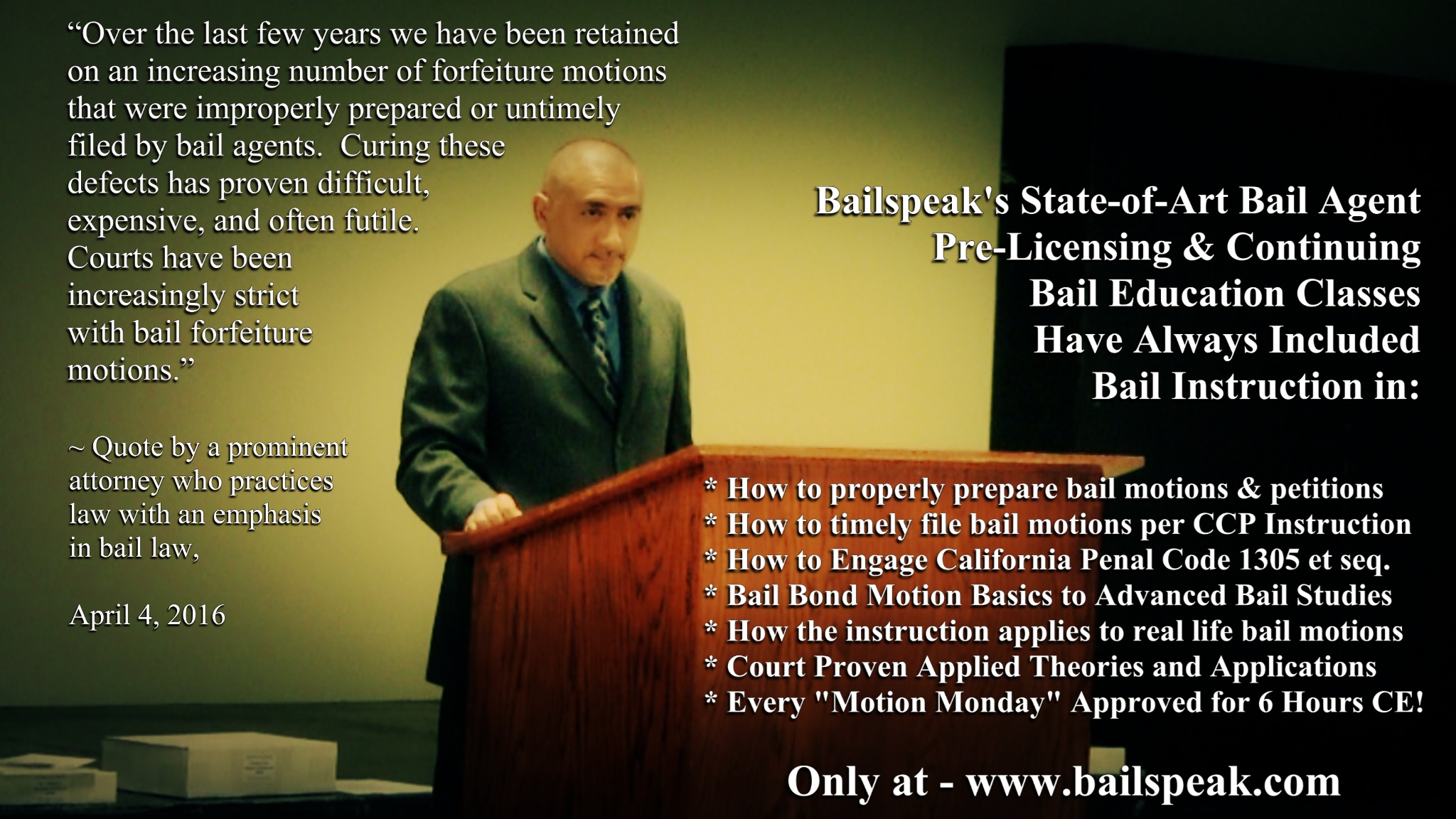
CONTACT REX VENATOR
Mon-Fri 9 AM to 3 PM
Office: 1-877-726-9092
Fax: 1-510-244-2841
You Should Always Contact an Attorney for Legal Advice
Copyright 2007 - 2025 Bailspeak, All Rights Reserved